

28%
54%

Literacy & Library Program · Since 2021
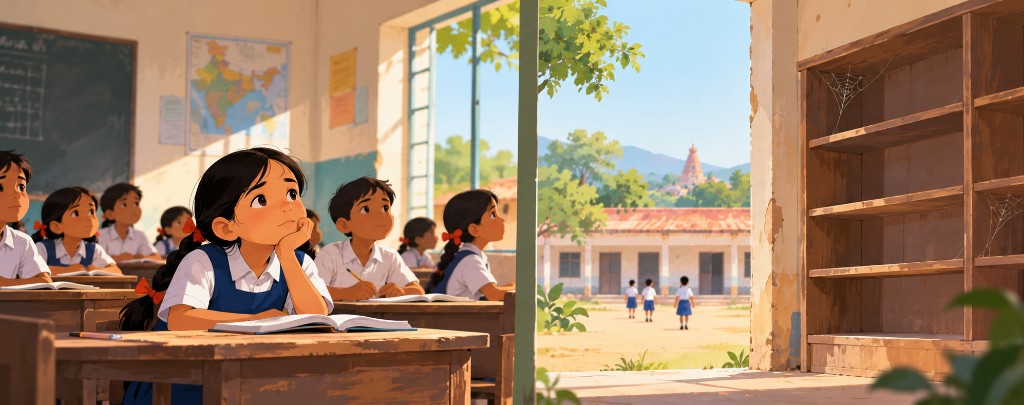
In Gaya’s government schools, many children have limited access to books beyond their textbooks. We bring libraries into schools and work with teachers to build reading habits, so every child has the opportunity to discover the joy of reading.

LLP combines library setup, library activities, teacher training, weekly classroom support to teachers and reading assessments for students. Through Sambodhi, the program extends the reading mission through district- and block-level implementation and expands its reach to more schools. The Children’s Literature Development Program (CLDP) supports government teachers in developing children’s books in four regional languages: Bhojpuri, Maithili, Magahi and Bajjika.
Bihar’s foundational literacy crisis runs deep. As per UDISE data from 2016–17,
95% of government schools lack a functional library or laboratory,
and the ASER 2018 report found that fewer than
35% of Grade 5 students could read a Grade 2-level text.
Karunodaya’s own baseline assessment of students across Grades 3–5 confirmed this reality on the ground: Most of the students were found to be non-fluent readers before any intervention began.
The need is especially acute in Gaya district, one of Bihar’s most underdeveloped and aspirational districts, where nearly 29% of the population belongs to Scheduled Castes and 16% to minority communities. Across 3,000 schools serving 6 lakh students, the dropout rate after primary school exceeds 15%, and the district records one of the highest illiteracy rates in India.
Our first year of implementation validated this model — non-fluent readers dropped from
71% 46%
and fluent readers nearly doubled from
28% 54%
But it also revealed real fragility. In the government schools of Gaya, only one of the two trained teachers is actively running sessions, meaning the library’s survival depends on a single individual. Activities like Storytelling, Balgeet, Read-Aloud, Roleplay and more library activities remain inconsistent, student discussions stay surface-level rather than reflective, and headmaster engagement is only in a few schools. Without sustained support and investment in school libraries, these gains may fade over time. With continued support, libraries can become an active and lasting part of school life, where reading becomes a regular practice for children.
Our approach moves through a clear, sequential model designed to build both infrastructure and human capacity, so that the library ultimately runs without us.
We begin with establishing separate rooms for the library, and for those who don’t have those separate rooms we set up a print-rich library corner in each school, with reading-level-curated books in children’s access.
Schools add two dedicated library periods in school routines built into the weekly school timetable for all the grades.
Then two nodal teachers per school are trained in core library activities such as Read-Aloud, Storytelling, Balgeet, Wall Magazine, Roleplay, Book Talk and more activities — using an “I Do, We Do, You Do” model that gradually shifts responsibility from our facilitators to the teachers themselves.
From ground learning, we saw that one teacher is more active than another teacher; in this case, our facilitators work intensively to activate the second teacher, co-facilitating sessions until that teacher can run them independently. Alongside this, teachers are trained in open-ended questioning techniques, moving student engagement beyond surface-level answers toward genuine comprehension and critical thinking.
We deliberately embed this work within the government system rather than running it in parallel. We hold regular meetings with Block Education Officers, District Education Officers, and DIET Gaya, sharing school-level reading data and positioning our model schools as templates the government can adopt on its own.
Parents are brought into the process through quarterly Parent-Teacher Meetings held inside the library itself, alongside a district-wide Children’s Literature Festival and Inter-School Reading Competition that build community ownership of reading culture.
We use two tools for Reading and Library Assessments of the Students and Schools
Sambodhi
Every Saturday in government schools across three blocks — Manpur, Nagar Prakhand and Bodhgaya — in Gaya, Bihar, older students (mentors) mentor two younger ones to read along with them. They earn credits, and those credits build their school library through the SoCCs Earning and Redemption Cycle.
Peer mentoring · Saturday reading · SoCCs credits · School library growth
28%
54%
71%
46%
32%
72%
35%
72%
51 libraries are now rated “vibrant”.
The 2023 batch repeated the result.
